Garage Door Springs 101: Types, Lifespan & Replacement
Garage door opener straining or knocking? Learn the basics of spring types, lifespan, and when replacement makes more sense than another adjustment.
Why Your Garage Door Opener Is Straining or Knocking
We recently got a call from a homeowner — we’ll call him Mark — who was pretty concerned about his garage door. The door would open, but it made a knocking sound and his opener sounded like it was really struggling to lift the door. He told us he suspected the springs were weak and not doing their fair share of the work.
When we asked a few questions, we learned he had a dual spring system mounted above the door, one spring on each side of the center bracket. Both springs were intact, but the door clearly wasn’t operating the way it should. Mark had already called a few different companies and was getting conflicting information about spring sizes, lifespans, and warranties.
That conversation is a perfect example of the confusion a lot of homeowners feel around garage door springs. So in this post, we’ll walk through the basics: the main types of springs, how long they really last, why your opener might be straining or knocking, and when it’s time to replace them.
The Job of Your Garage Door Springs
Garage door springs are the real muscle of the system. The opener is more like the “guide” or controller. If the springs are sized and adjusted correctly, the door should feel almost weightless when lifted by hand.
When springs start to fail or go out of adjustment, a few things usually happen:
- The opener sounds louder or like it’s straining to pull the door up.
- You may hear knocking, jerking, or banging as the door travels.
- The door may feel heavy if you try to lift it manually (with the opener disconnected).
- The opener may reverse unexpectedly or stop mid-cycle.
All of these can point to springs that are worn, out of balance, or broken — or to a system that simply needs a professional tune-up.
Two Main Types of Garage Door Springs
On Mark’s call, we asked whether he had a single or dual spring system, and where the springs were located. That helped us determine what we were dealing with. Most residential doors use one of these setups:
Torsion Springs (Above the Door)
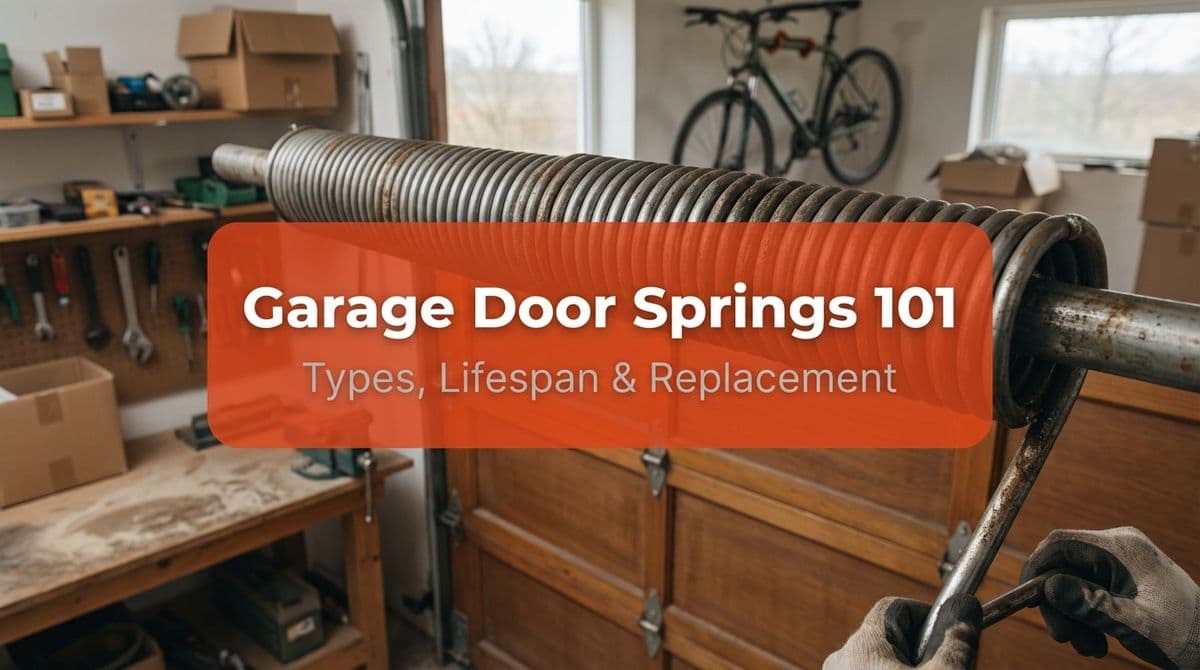
This is what Mark had. Torsion springs are mounted on a metal shaft above the top of the door, usually in the center, sometimes with one spring on each side of a center bracket. These springs twist (torsion) to store energy and unwind to lift the door.
Key points about torsion springs:
- Common diameters are around 2 inches, which is what we typically use.
- They’re available in different wire sizes and lengths to match your specific door weight and height.
- They provide smoother, more controlled lifting compared to extension springs.
Extension Springs (Along the Tracks)
Extension springs run along the sides of the horizontal tracks, stretching and contracting as the door moves. They’re more common on older systems or budget installations.
Key points about extension springs:
- They stretch out as the door closes and contract as it opens.
- They can be more prone to uneven lifting if one spring weakens before the other.
- Modern setups should have safety cables running through the center of the spring to contain it if it breaks.
Spring Size, Quality, and Cycle Life
Mark mentioned that some companies told him they used “one-inch” springs and others “two-inch” springs, and he was understandably confused. What really matters with torsion springs is that they’re properly sized for the door and built to a solid cycle rating.
Here’s how we look at it:
- Diameter: We typically use 2-inch diameter torsion springs for standard residential doors. This is a very common, proven size.
- Cycle rating: Our springs are high-cycle, generally rated for 12,000+ cycles. One “cycle” is one full open and close.
- Origin and quality: We use American-made springs built to consistent standards so we know what to expect from their performance and lifespan.
Springs wear out based on how many times the door is used, not just how many years go by. For most homeowners, we typically see a realistic lifespan of about 7–15 years. Heavy users — for example, if you run a small business out of your garage and are in and out all day — might be toward the lower end of that range.
Why Your Opener Is Straining or Knocking
During Mark’s call, he described knocking and a sense that the opener was “putting a lot of pressure” on itself to get the door open. That raised a few possibilities we see often:
- Springs losing tension: Over time, springs can lose some of their torque. The door slowly gets heavier for the opener, which leads to straining sounds.
- Unbalanced door: If one spring in a dual system is weaker, or the door is out of balance, the opener has to fight the imbalance every time it runs.
- Lack of lubrication: Dry rollers, hinges, and bearings can cause knocking or jerking, even if the springs are technically intact.
- Operator force settings off: The opener’s force settings may be too high or too low, causing noisy operation or frequent reversals.
In many cases, as we told Mark, a professional tune-up can make a big difference: checking the spring balance, making minor tension adjustments where appropriate, lubricating the moving parts, and correctly setting opener force and travel limits.
When It’s Time to Replace Your Garage Door Springs
Springs don’t last forever, and at some point replacement is the safest and most cost-effective option. Consider replacement if:
- You see a visible gap in a torsion spring (this means it has snapped).
- One side of the door lifts higher than the other or the door looks crooked.
- The opener struggles even after a tune-up and proper lubrication.
- You’re within that 7–15 year window and the door has heavy daily use.
On Mark’s call, we also went over estimates, warranties, and the type of springs we use, because that’s information every homeowner should have up front. When we quote spring replacement, we’re factoring in the correct spring size for the specific door, the cycle rating, the included warranty, and professional installation and adjustment.
A Quick but Important Safety Reminder
We always like to close with this: garage door spring work is dangerous. Springs are under a tremendous amount of tension. Improper handling, DIY winding, or using the wrong tools can result in serious injury.
Homeowners can safely:
- Visually inspect for gaps, rust, or broken parts.
- Listen for new noises like knocking, grinding, or loud pops.
- Keep tracks and surrounding areas free of debris.
But when it comes to adjusting or replacing springs — especially torsion springs — it’s best to bring in a professional.
If your garage door opener sounds like it’s straining, knocking, or just not operating the way it used to, we’re happy to come out, give everything a thorough inspection, and let you know whether a tune-up will do the trick or if it’s time to talk about new springs.