Should You Replace One or Both Garage Door Springs?
Not sure whether to replace one garage door spring or both? Learn how we help homeowners decide, and what to do if a spring breaks right before you sell.
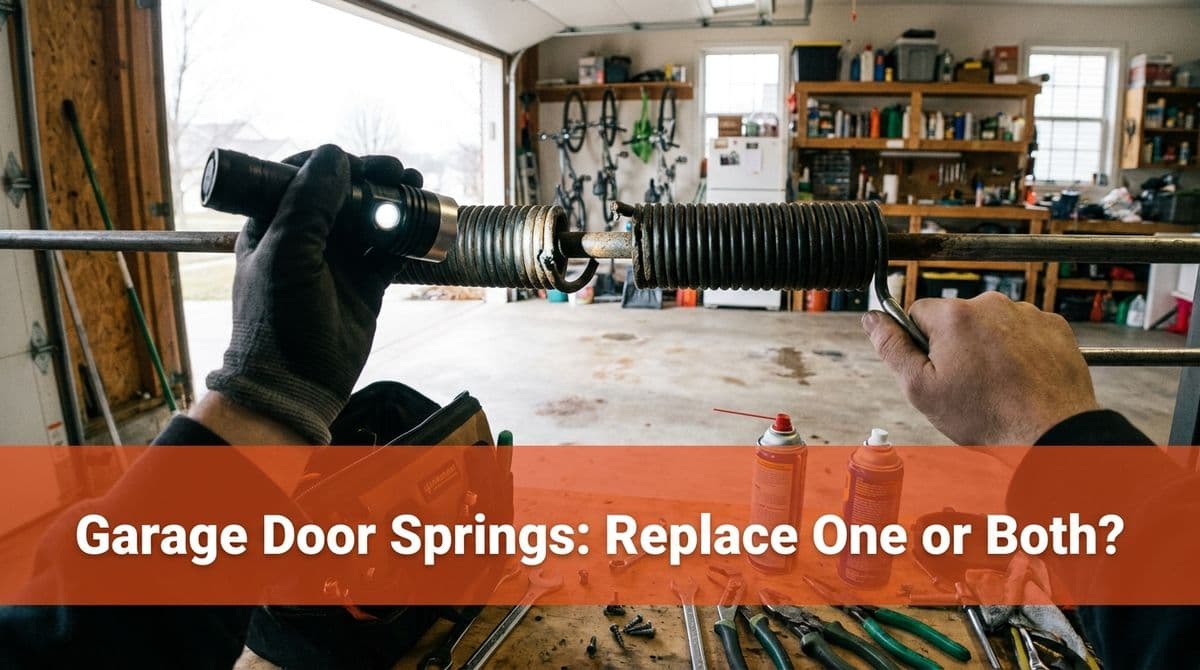
“Do I Really Need Both Springs?” A Call That Comes Up All the Time
We recently got a call from a homeowner — let’s call him Mike — who was in the middle of packing up to move. He went to open his garage door, heard a loud bang, and suddenly the door wouldn’t budge. A quick look up above the door showed one of his torsion springs snapped clean in two.
Mike told us, “It’s a dual setup. One spring’s broken, the other one looks fine. We’re moving soon — I just need the door to work so we can get our stuff out and the next folks can get their stuff in. Do I really need both springs replaced, or can we just do the one?”
That’s a very common — and very reasonable — question. Let’s walk through how we helped Mike decide what to do, and what we usually recommend for homeowners in the same situation.
How Garage Door Springs Actually Work
Your garage door springs do the heavy lifting. The door itself can weigh 150–300+ pounds, and the torsion springs (the ones mounted on the bar above the door) are what counterbalance that weight so your opener doesn’t have to struggle.
In a dual spring setup, both springs are designed to share the load. In most homes:
- Both springs were installed at the same time
- They have the same life expectancy (rated in “cycles” — one open and close is a cycle)
- They wear out at roughly the same rate
So when one finally snaps — often with that scary gunshot sound — the other one is usually not far behind in terms of wear.
When We Recommend Replacing Both Garage Door Springs
With Mike, the first thing we asked was what we usually ask every homeowner: “Do you know when these springs were installed?” In his case, the answer was no, which usually means they’re older.
Here’s when we typically recommend replacing both springs at the same time:
1. The home is your long‑term residence
If you plan to stay in the home, replacing both springs is almost always the smarter move. Why?
- Balanced performance: A new spring paired with a worn spring can throw off the balance of the door and put extra stress on the opener.
- Fewer surprise breakdowns: The second spring is usually near the end of its life, so it’s very common for it to break within months of the first one.
- Save a second service call: Two trips will cost more in the long run than doing both springs while we’re already on-site.
2. You know both springs are the same age
If you had them installed together, or the door is original to the house, it’s safe to assume they’ve seen the same number of cycles. That makes it a good time to do both and “reset the clock” on your spring system.
3. You want maximum reliability and warranty coverage
Most quality springs come with a parts warranty. When both are replaced at once, you have a matched, warrantied set instead of one old and one new part with different remaining life spans.
When It Can Make Sense to Replace Just One Spring
Now, here’s where Mike’s situation comes in. He let us know, “We’re moving. I just need the door functional for a bit. I’m not trying to overhaul the whole system.”
In cases like this, replacing just the broken spring can be perfectly reasonable. We usually consider a single spring replacement when:
1. You’re about to sell your house
If you’re listing soon or already under contract, your main goals are usually:
- Make the door safe and functional for inspections and move‑out
- Keep repair costs reasonable
- Avoid delays to closing
Many of the real estate and property management clients we work with handle it this way: if one spring breaks right before a sale, they’ll approve a single spring replacement to get the door working and move on. The next homeowner can decide when to tackle a full spring upgrade later.
2. The other spring was recently replaced
If one spring was replaced in the last year or two and the other is original, and now that older one snaps, we’ll often recommend replacing just the broken one. You already have one relatively new spring — it doesn’t make sense to throw that away.
3. You understand the trade‑offs
We’re always upfront about what you’re choosing. If you only replace one spring:
- The door will be safe and functional after the repair
- The remaining old spring may break sooner rather than later
- There’s a chance you’ll need another service call down the road
For Mike, who was moving and just needed the door working reliably for a short window, a single spring replacement with a parts warranty was a practical solution.
If You’re Selling Soon: How to Decide What’s “Enough”
If you’re in the same boat Mike was — boxes everywhere, showings scheduled, and suddenly a broken spring — here’s how we suggest thinking it through:
- Talk to your agent: Ask if the buyers or inspector are likely to flag an older but working spring system, or if a basic repair is sufficient.
- Ask your technician to inspect the whole system: We’ll look at cables, rollers, hinges, and the opener while we’re there. If something is unsafe, we’ll tell you.
- Be realistic about timing: If your closing is in a week, a single spring replacement that can be done same‑day often makes the most sense.
- Consider disclosure: If you know the other spring is older, your agent may recommend a simple note in the disclosure forms that the broken spring was replaced recently.
The goal is to keep the door safe, functional, and inspection‑ready without over‑investing right as you’re walking out the door.
Safety Note: Don’t Try to DIY a Broken Spring
One last thing we always tell homeowners like Mike: garage door spring replacement is not a DIY project. Those springs are under tremendous tension. The wrong move with the wrong tools can cause serious injury or damage.
If you hear a bang, see a spring in two pieces, or notice the door feels impossibly heavy to lift manually, call a pro. A typical spring repair for us takes about 30–60 minutes, and we’ll make sure the door is balanced, lubricated, and operating safely before we leave.
Still Unsure Whether to Replace One Spring or Both?
If you’re staring at a broken spring right now and trying to decide what to do, you don’t have to figure it out alone. When we come out, we’ll:
- Inspect both springs and the rest of your door system
- Ask about your plans (staying long‑term vs. selling)
- Walk you through the pros and cons of one vs. both, in plain language
From there, you can make the call that fits your situation and your budget — just like Mike did.